
Health

The greatest responsibility of a dog breeder is taking care to produce the healthiest puppies possible. This is particularly true for rare breeds like the Drent with limited genetic diversity. Poor breeding decisions tend to amplify problems in future generations. That's why California Drents makes no compromises in health testing. We are fortunate that the Drent is generally a healthy breed. The incidence of cancer, for example, is not common and most Drents live to a good age. Nonetheless, there are health issues in the Drent that can be serious and are far more prevalent than in similar breeds. In each case, there is a strong link to genetics. Careful and deliberate breeding decisions can reduce these risks if not eliminate them entirely. Elbow dysplasia and von Willebrand Disease are two health issues known to the Drent.

  • California Drents will not breed dogs with elbow dysplasia.
  • California Drents will not produce puppies affected with von Willebrand Disease
  • California Drents will produce puppies clear of genetic markers of von Willebrand Disease

Elbow Dysplasia

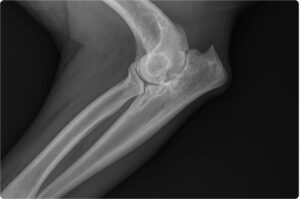
Elbow dysplasia (ED) refers to the abnormal development of the elbow joint, resulting in early development of osteoarthritis and degenerative changes. ED can be a debilitating disease requiring regular injections, surgery, and in extreme cases euthanasia. Some Drents with ED may not exhibit symptoms until later in life as the disease is progressive.

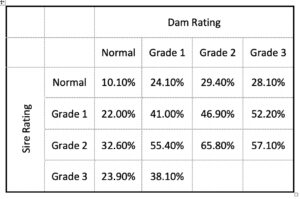
The genetic link to ED is unquestionable. The odds of a puppy having ED more than doubles when even one parent has been diagnosed.[i] This is true whether the parent has unilateral or bilateral ED.


ed radiograph

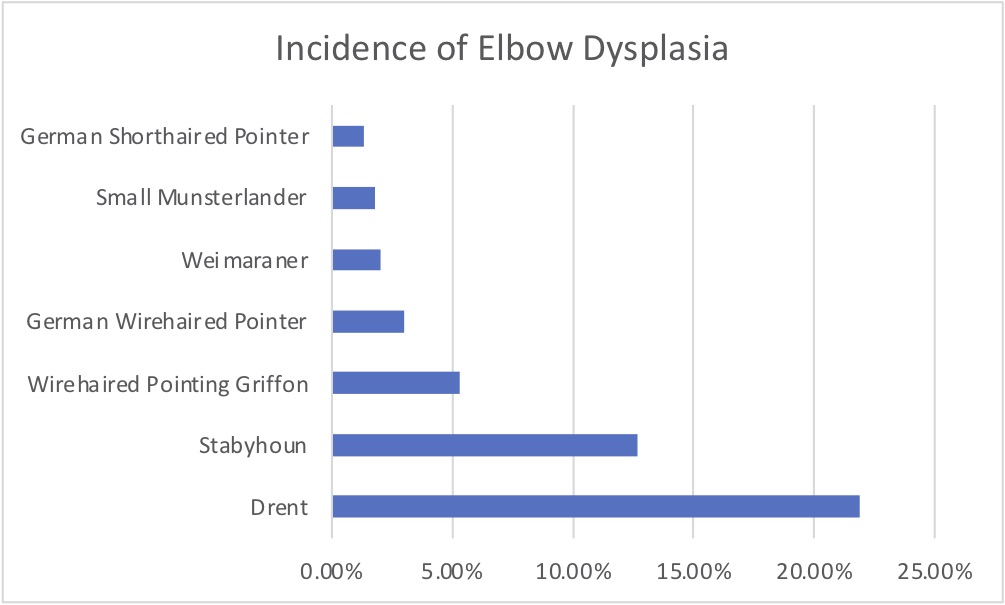
How common is ED in the American Drent population compared to other breeds? Statistics are published by the Orthopedic Foundation for Animals (OFA), which collects data from tested dogs. Typically, only prospective breeding dogs are tested, a self-selected population of presumably healthy dogs.

Elbow dysplasia is much more common in the Drent than in comparable hunting breeds. Why is this? ED was not monitored in the Dutch Drent population until relatively recently, so breeders may not have had the necessary information to make better breeding decisions. The American Drent breeding stock comes from that population, so it isn’t surprising to see ED here.

That’s not the full story, however. Armed with the knowledge that ED is hereditary, some breeders still make the choice to use ED diagnosed dogs in their programs. The Drent population is small, but the vast majority of tested Drents remain free of ED. There is no need to use ED affected Drents in breeding programs. Doing so only perpetuates ED in the Drent population.

Veterinary science is unequivocal: “Rigorous use of screenings for breeding animals (with full public information) is currently the best bet for decreasing cases of elbow dysplasia. Normal parents may produce elbow problems, but the incidence is much lower than if one or both parents have bad elbows themselves.”[iii]

There is only one way to reduce the risk of ED in our Drent population: ethical breeding. We will still see some offspring with ED even if neither parent was diagnosed. That’s because some parents have siblings and other close relatives with ED and therefore carry some of the genetic characteristics for ED. Nevertheless, the data shows that ED is less likely to be present so long as the parents are free of ED.

[i] G. Bears et al, Heritability of Unilateral Elbow Dysplasia in the Dog: A Retrospective Study of Sire and Dam Influence, Front. Vet. Sci., 21 November 2019 (https://www.frontiersin.org/journals/veterinary-science/articles/10.3389/fvets.2019.00422/full)

[ii] G. Gregory Keller, Edmund Dziuk, Jerold S. Bell, How the Orthopedic Foundation for Animals (OFA) is tackling inherited disorders in the USA: Using hip and elbow dysplasia as examples, The Veterinary Journal, Volume 189, Issue 2, August 2011 (https://www.sciencedirect.com/science/article/abs/pii/S1090023311002334?via%3Dihub)

[iii] https://www.vet.cornell.edu/departments-centers-and-institutes/riney-canine-health-center/canine-health-information/elbow-dysplasia


ed table

Rate of elbow dysplasia in progeny between parents with known elbow scores[ii]


ED Incidence

VWD Image


cornell logo

von Willebrand Disease

von Willebrand Disease (vWD) is a bleeding disorder found in many breeds of dogs and even in humans. It should not be confused with the far more serious disorder of hemophilia. A dog with vWD possesses some but not all of the many blood proteins that cause clotting. A vWD-affected dog will bleed more than a vWD-free dog following an injury or surgery and therefore has a greater risk of dangerous blood loss. Even routine surgeries require special blood products on hand in case of excessive bleeding.

vWD is genetic and is readily tested with a cheek swab:

  • a dog with two copies of the gene, one from each parent, is affected with vWD.
  • a dog with one copy of the gene is a carrier of vWD. It will not exhibit the same bleeding risks as affected dogs but will pass on a copy of the gene to offspring.
  • a dog without a copy of the vWD gene is free.

The likelihood of vWD-affected offspring is determined by the genetic status of the parents:
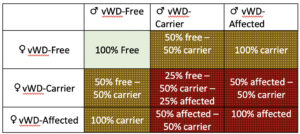
vwd matrix

The Code of Ethics for the Drentsche Patrijshond Club of America requires testing every breeding animal for vWD. Not all Drent breeders subscribe to this Code of Ethics. Consequently, vWD-affected Drents can still be produced even though it would not be ethical.

Unless at least one of the parents is vWD-free, the odds are that 25% to 100% of the puppies will be vWD-affected. If the breeding female is not vWD-free, then the breeder must select a vWD-free stud. This simply isn’t happening enough because too many breeders elevate production over health. Some breeders don’t even disclose the vWD status of their dogs on their websites.

Nothing stated here is controversial in veterinary science. The Cornell College of Veterinary Science recommends:

Carriers should be bred to test-clear mates. Some puppies in these matings will test in the normal range. By increasing the number of clear to clear matings in subsequent generations, the proportion of VWD carriers in a line will be gradually reduced, without losing desirable traits. Carrier to carrier matings are undesirable, because these crosses are likely to produce the most severe form of VWD in offspring. Do not breed any dog that expresses abnormal or excessive hemorrhage.[i]

Some breeders brush off concerns over vWD. Some or all of these breeders are also making the choice to breed vWD carriers or affected dogs without evident concern for the outcome. They may rationalize that vWD-affected dogs don’t necessarily bleed out from injuries or surgeries. They may claim that the DNA test for vWD isn’t valid for the Drent, although the test was expressly validated for the Drent more than ten years ago in cooperation with the DPCA. Those breeders may have a vested interest in breeding the dogs they have regardless of vWD outcomes. Or they may be breeding for a “look” that suits their personal preference regardless of health outcomes. The only clinically-valid alternative test for vWD is the far more expensive blood assay to directly measure the von Willebrand Factor.

The DPCA Code of Ethics encourages the improvement of the health of the Drent over successive generations. Elimination of all health issues isn’t feasible, but risk reduction isn’t complicated.

[i]  https://www.vet.cornell.edu/animal-health-diagnostic-center/laboratories/comparative-coagulation/clinical-topics/canine-von-willebrand-disease#inheritance